Showing posts with label digital SLR camera. Show all posts

Tuesday, November 1, 2016

Sony’s next A7 camera is going to be announced in March/April

Sony’s next A7 camera is going to be announced in March/April

 
Sony will start to “refresh” their A7 line with the new A7 mark III. The camera will start shipping out in March/April according to SonyAlphaRumors. No specs are given yet. rnss Thumbs up17 Love1 Joy1 Surprised3 Sad2 Angry7 Share on…

sony-a7ii-grip

The post Sony’s next A7 camera is going to be announced in March/April appeared first on mirrorlessrumors.

mirrorlessrumors


Check out the Resources of Digital Photography School for more books or courses on Photography.
Visit here for more on Camera Tips.
Read more on Digital Photography.
FacebookTwitterGoogle+Pinterest


Wednesday, April 6, 2016

A7RIII 80 megapixel rumor – Let’s talk about why I love the Megapixel race (not what you think)

by John Aldred


Sony Alpha Rumours have made a lot of buzz the last couple of days by announcing that they’ve received some hints about the potential size of images that may be produced by the Sony A7RIII.  According to their source… a7Riii the new sensor will be between 70 – 80 Megapixels. They are working on improved IBIS [...]

 Read more :  The post A7RIII 80 megapixel rumor – Let’s talk about why I love the Megapixel race (not what you think) appeared first on DIY Photography.


 Read more on SLR Camera.


Thursday, March 10, 2016

Canon announces budget-friendly EOS Rebel T6 (1300D)


 Canon has announced its latest entry-level DSLR, the Rebel T6, which is known as the EOS 1300D in most regions. The T6 is a relatively minor update to the Rebel T5 (EOS 1200D) and adds a faster Digic 4+ processor, higher resolution LCD, 'white priority' WB mode (which produces more neutral color in tungsten lighting), a food scene mode and Wi-Fi with NFC.

 The T6 retains the same 18MP APS-C CMOS sensor, 9-point AF system, Full HD video capture and numerous scene and creative modes as its predecessor.
The Rebel T6 will ship in the US next month at a price of $ 549, which includes the 18-55mm F3.5-5.6 IS II lens.


Press release:

Share moments on-the-go with the new Canon EOS Rebel T6 DSLR Camera

Become the next Internet sensation with built-in Wi-Fi®and NFC connectivity*
MELVILLE, N.Y., March 10, 2016 – Canon U.S.A., Inc., a leader in digital imaging solutions, today announced its newest entry-level DSLR camera, the EOS Rebel T6. The Canon EOS Rebel T6 camera offers easy sharing of high quality photos and videos to popular social media sites via compatible smartphones and other mobile devices* as well as Canon’s Connect Station CS100.
“Smartphone users passionate about photography and ready to take that next step to creating their best images and videos ever will appreciate the ease-of-use and affordability of the new EOS Rebel T6 camera,” said Yuichi Ishizuka, president and COO, Canon U.S.A., Inc. “With the latest addition of the EOS Rebel T6 camera, the Canon EOS Rebel series continues to be one of the most popular DSLR camera lines on the market.”
The Canon EOS Rebel T6 DSLR camera offers a wide range of features including:
  • 18.0 Megapixel Canon CMOS (APS-C) image sensor and high-performance DIGIC 4+ Image Processor for excellent image quality and speedy operation.
  • ISO 100–6400 (expandable to H: 12800) for shooting from bright light to low light.
  • Built-in Wi-Fi® and NFC connectivity* for easy sharing to smart devices, social media sites and the Canon Connect Station CS100 device.
  • 9‐point AF system (including one center cross‐type AF point) and AI Servo AF provide impressive autofocus performance with accurate results.
  • High-performance Optical Viewfinder helps facilitate quick and accurate focusing by firmly framing and capturing the subject at hand.
  • Large, 3.0-inch LCD monitor with 920,000 dots for easy viewing and reviewing.
  • Full HD video mode for high quality, easy-to-use video capture.
Missed Photo Ops a Thing of the Past
The Canon EOS Rebel T6 camera provides a wide ISO range of 100-6400 (expandable to ISO 12800), making it ideal for shooting both still and moving subjects in a wide variety of lighting conditions ranging from low light to bright sunny days. In addition, the camera is capable of shooting high-resolution 18 megapixel still photos continuously up-to-three frames per second (fps), with predictive autofocus to help keep every image sharp and clear, even with moving subjects.
The Scene Intelligent Auto mode in the Canon  EOS Rebel T6 camera analyzes the image, accounting for faces, colors, brightness, moving objects, contrast and whether the camera is handheld or on a tripod. Scene Intelligent Auto mode then chooses the exposure and enhancements that can bring out the beauty in virtually any scene or situation. Simplifying DSLR image capture, Scene Intelligent Auto mode lets you concentrate on composing images without puzzling over settings.
Another exciting addition to the Canon EOS Rebel T6 camera is a new ‘Food Mode’ on the mode dial for the foodie or blogger to easily capture stunning images of the food they love. This mode enhances the color and brightness of the food images while at the same time making the images ready to share. Other fully automatic exposure modes include portrait, night portrait, landscape, sports, and close-up. Additionally, the easy-to-use Full HD video mode captures sharp, high-definition video up to 1080p resolution with the choice of automatic or manual focusing. Creative filters such as Fisheye, Toy Camera, Miniature, and Soft Focus give users additional ways to create fun and imaginative images to enjoy, print and share.  The camera’s new “white priority” Auto White Balance setting enables users to create images with a more neutral tone when shooting under incandescent lighting. In addition to all the automatic modes, the new Canon EOS Rebel T6 camera provides complete manual exposure and focus controls plus RAW image output for advanced amateur photographers and photography students.
The Canon EOS Rebel T6 camera is compatible with the entire Canon EF and EF-S lens system including over 60 current models enabling users to capture their world in different perspectives ranging from Fisheye to Super-Telephoto. Scheduled for availability in April 2016, the estimated retail price of the Canon EOS Rebel T6 camera will be $ 549.99** when bundled with the EF-S 18-55mm f/3.5-5.6 IS II standard zoom lens.
* Compatible with iOS® versions 7.1/8.4/9.0, AndroidTM smartphone and tablet versions 4.0/4.1/4.2/4.3/4.4/5.0/5.1.  Data charges may apply with the download of the free Canon Camera Connect app. This app helps enable you to upload images to social media services. Please note that image files may contain personally identifiable information that may implicate privacy laws. Canon disclaims and has no responsibility for your use of such images. Canon does not obtain, collect or use such images or any information included in such images through this app.
**Availability, prices, and specifications are subject to change without notice. Actual prices are set by individual dealers and may vary.

Canon EOS Rebel T6 / EOS 1300D specifications

Price
MSRP$ 549.99 (with 18-55mm F3.5-5.6 IS II lens)
Body type
Body typeCompact SLR
Body materialComposite
Sensor
Max resolution5184 x 3456
Other resolutions3456 x 2304, 2592 x 1728, 1920 x 1080, 720 x 480
Image ratio w:h1:1, 4:3, 3:2, 16:9
Effective pixels18 megapixels
Sensor photo detectors19 megapixels
Sensor sizeAPS-C (22.3 x 14.9 mm)
Sensor typeCMOS
ProcessorDigic 4+
Color spacesRGB, AdobeRGB
Color filter arrayPrimary color filter
Image
ISOAuto, ISO 100-6400, expandable to 12800
Boosted ISO (maximum)12800
White balance presets6
Custom white balanceYes
Image stabilizationNo
Uncompressed formatRAW
JPEG quality levelsFine, Normal
File format
  • JPEG
  • RAW (Canon CR2, 14-bit)
Optics & Focus
Autofocus
  • Contrast Detect (sensor)
  • Phase Detect
  • Multi-area
  • Center
  • Selective single-point
  • Tracking
  • Single
  • Continuous
  • Face Detection
  • Live View
Autofocus assist lampYes (flash)
Digital zoomNo
Manual focusYes
Number of focus points9
Lens mountCanon EF/EF-S
Focal length multiplier1.6×
Screen / viewfinder
Articulated LCDFixed
Screen size3″
Screen dots920,000
Touch screenNo
Screen typeTFT LCD
Live viewYes
Viewfinder typeOptical (pentamirror)
Viewfinder coverage95%
Viewfinder magnification0.8×
Photography features
Minimum shutter speed30 sec
Maximum shutter speed1/4000 sec
Exposure modes
  • Scene Intelligent Auto
  • Program
  • Shutter Priority
  • Aperture Priority
  • Manual
Scene modes
  • Landscape
  • Close-up
  • Sports
  • Food
  • Night Portrait
Built-in flashYes (Pop-up)
Flash range9.20 m (at ISO 100)
External flashYes (via hot shoe)
Flash modesAuto, On, Off, Red-eye
Flash X sync speed1/200 sec
Drive modes
  • Single
  • Continuous
  • Self-timer
  • Continuous w/self-timer
Continuous drive3.0 fps
Self-timerYes (2 or 10 sec)
Metering modes
  • Multi
  • Center-weighted
  • Partial
Exposure compensation±5 (at 1/3 EV, 1/2 EV steps)
AE Bracketing±2 (3 frames at 1/3 EV, 1/2 EV steps)
WB BracketingYes
Videography features
Resolutions1920 x 1080 (30p, 24p), 1280 x 720 (60p), 640 x 480 (30p)
FormatMPEG-4, H.264
MicrophoneMono
SpeakerMono
Storage
Storage typesSD/SDHC/SDXC card
Connectivity
USBUSB 2.0 (480 Mbit/sec)
HDMIYes (mini-HDMI)
Microphone portNo
Headphone portNo
WirelessBuilt-In
Wireless notes802.11b/g/n with NFC
Remote controlYes (wired or wireless)
Physical
Environmentally sealedNo
BatteryBattery Pack
Battery descriptionLithium-Ion LP-E10 rechargeable battery & charger
Battery Life (CIPA)500
Weight (inc. batteries)485 g (1.07 lb / 17.11 oz)
Dimensions129 x 101 x 78 mm (5.08 x 3.98 x 3.07″)
Other features
Orientation sensorYes
GPSNone 

Articles: Digital Photography Review (dpreview.com)

If you are interested in Digital Camera, check it out here for more details.


Sunday, December 27, 2015

Sony Alpha A7S Mirrorless Digital SLR Camera

Sony Alpha A7S Mirrorless Digital SLR Camera 4K Wi-Fi Body

ITEM DETAILS AND DESCRIPTIONS - PKG #8297

 
Sony Alpha a7s Mirrorless Digital Camera
 
 
Sony Alpha a7s Mirrorless Digital Camera


Sony Alpha a7s Mirrorless Digital Camera

The Sony Alpha a7S Mirrorless Digital Camera features a full-frame 12.2MP Exmor CMOS sensor and BIONZ X image processor to enable notable video and still image quality with an expansive dynamic range, low noise, and extended sensitivity to ISO 409600. At the sensor level, this full-frame sensor features a unique on-chip gapless lens design, which incorporates small lenses between neighboring pixels in order to increase light-gathering efficiency and promote greater image quality across the entirety of the sensor plane. The sensor and processor combination also avails a wealth of speed throughout the camera system, including a top continuous shooting rate of 5 fps, support for 4K video recording, and a fast 25-point contrast-detection AF system with sensitivity to -4 EV.
* 12.2MP Full-Frame Exmor CMOS Sensor
* BIONZ X Image Processor
* Gapless On-Chip Lens Design
* 3.0" 921.6k-Dot Tilting LCD Monitor
* XGA 2.36M-Dot OLED Electronic Viewfinder
* Full HD Recording in XAVC S
* 4:2:2 UHD 4K Output via HDMI
* Full Pixel Read-Out, S-Log2 Gamma
* Expandable Sensitivity: ISO 50-409600
* Fast Intelligent 25-Point AF System
In The Box:
* Lithium-Ion Rechargeable Battery
* Battery Charger (Black)
* AC Adapter
* Micro USB Cable
* Body Cap
* Shoulder Strap
* Cable Protector

Visit http://slrcamera.org/ for more SLR Cameras.

Saturday, September 19, 2015

Adding Dew Drops to Enhance Macro Nature Photography

Adding Dew Drops to Enhance Macro Nature Photography

Here is a secret weapon to add to your camera bag. It’s another simple tip that can take your nature photos to a whole new level!

dew drop photography
Photo captured by Agus Supriyanto

Flower photography is what got a lot of us interested in photography in the first place. Even if flower photography wasn’t part of you getting bitten by the photo bug, and you have no interest in them at all, they’re a very good subject to practice on and learn to master your photo equipment.
Have you noticed that with most stunning flower photos, they are covered with dew drops?
The same with spider webs. In fact, in this case, dew drops are an essential element of the shot. They shimmer, sparkle, and reflect, and they really make your photo come to life! In fact, without dew drops, a spider web photo is fairly boring.
Here is a secret… the dew drops are rarely—if ever—real.
The photographer’s secret weapon that should always be in your camera bag is a small spray bottle of water.
This way, no matter what time of day you’re shooting and no matter if there is dew or not, just give the flower a few spritzes and voila! You have a dew covered flower.
dew on grass
“Dewdrops4” captured by Anja Pietsch

That’s how the pros do it, they are not searching out flowers and spider webs with natural dew drops!
Here is another tip. Sometimes with a spray bottle, we don’t get “dew drops” that are big enough to read well in the photo. Do you want the dew drops to be a bit bigger?
Try adding some glycerin to the water. It will help the water molecules bond together and make bigger “dew drops.” By the way, if you get thirsty, don’t drink the water and glycerin mix. Hydrate in some other way.
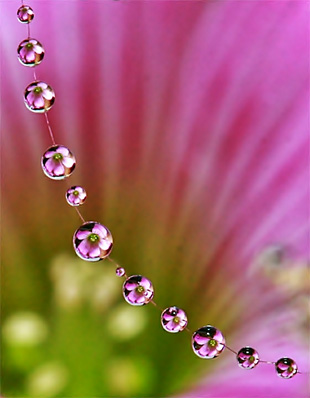
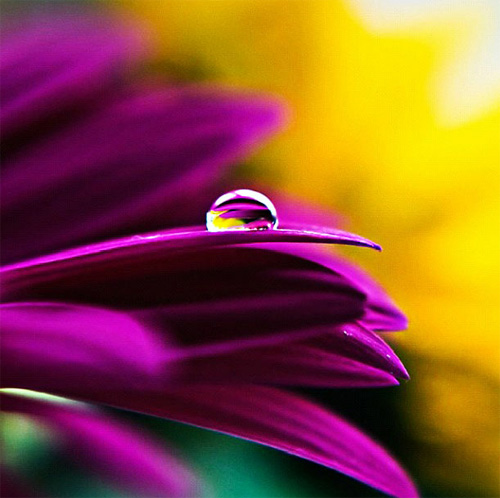
Adding glycerin and making the drops larger is almost essential if you want to get one of those close-up shots of a single dew drop reflecting the flowers behind it. Theese types of photos have better than average chance of doing well in photo contests.
dew drop
“h2o” captured by trek
Make today the day you commit to being the kind of photographer you dreamed of being when you first got into photography. You can do it—it’s not that hard. Add a glycerin-water bottle to your camera bag so it’s always available, and use flowers and spider webs as practice subjects. Who knows, that next photo contest winner could be you!

About the Author:
Dan Eitreim writes for ontargetphototraining.com. He has been a professional photographer in Southern California for over 20 years. His philosophy is that learning photography is easy if you know a few tried and true strategies.

Go to full article: Adding Dew Drops to Enhance Macro Nature Photography
What are your thoughts on this article? Join the discussion on Facebook or Google+

Article from: PictureCorrect


http://slrcamera.org/adding-dew-drops-to-enhance-macro-nature-photography/

This entry was posted in SLR Camera Guide and tagged . Bookmark the permalink. 

Saturday, July 18, 2015

Digital SLR Camera Overview


SLR cameras allow for more accurate composition and colour balance since what you see through the viewfinder will be what you get in the final picture.
Traditional SLR cameras used film but today's digital SLR cameras allow for digital capture so that you can review your images instantly.

DSLR cameras often have image sensors of much larger size and often higher quality, offering lower noise, which is useful in low light. Although mirrorless digital cameras with APS C and full frame sensors exist, most full frame and medium format sized image sensors are still seen in DSLR designs.

DSLR cameras are highly valued by military photographers because of their resolution, sensitivity, versatility in the field, availability of a wide variety of objective lenses and because they allow an accurate preview of framing close to the moment of exposure.

Many photographers also prefer dSLRs for their larger sensors compared to most compact digital cameras, now available with image sensors the same size as traditional film formats. These large sensors allow for similar field of view values to film formats, as well as their comparable sensitivity.

The SLR camera price can differ from store to store. There are the best brands with great prices and discounts. You will find the best SLR camera with the best features in the most popular brands. The Nikon, Canon, Pentax are some of the popular brands in India. The SLR camera price ranges from $ 299 to a more expensive range of SLR camera.

Most SLR cameras permit upright and laterally correct viewing through use of a roof pentaprism situated in the optical path between the reflex mirror and viewfinder.
Light, which comes both horizontally and vertically inverted after passing through the lens, is reflected upwards by the reflex mirror, into the pentaprism where it is reflected several times to correct the inversions caused by the lens, and align the image with the viewfinder.

When the shutter is released, the mirror moves out of the light path, and the light shines directly onto the film (or in the case of a DSLR, the CCD or CMOS imaging sensor). The Canon Pellix film camera was an exception to the moving mirror system, wherein the mirror was a fixed beamsplitting pellicle.

Digital SLR cameras, along with most other digital cameras, generally have a mode dial to access standard camera settings or automatic scene mode settings. Sometimes called a "PASM" dial, they typically provide as minimum Program, Aperture priority, Shutter priority, and full Manual modes. Scene modes vary and are inherently less customisable. They often include full auto, landscape, portrait, action, macro, and night modes, among others.

Professional DSLRs seldom contain automatic scene modes as professionals do not require these. Digital SLR cameras can be bought as kits or camera body only, where you have to buy the lens separately. The SLR camera kit is popular, and adequate, for photography beginners; and the more experienced person will usually know what kind of lens to get.

The photography novice can find a great deal of satisfaction with the kit lens. If you do some pricing you'll see that the kits go for much less than making two different purchases for body and lens. That piece of helpful info can save you money when you're talking to a sales rep just in case. Another potential situation is shopping on the web; so just remember that SLR camera kits are available and can be bought. It doesn't matter if you buy offline or online, be very sure of what you're getting with the price you're paying.

Although SLR cameras are more expensive than the regular digital cameras but they provide the photographers the facility to obtain a better picture quality and ultimate output with their superior technology.
Speed DSLR cameras are much quicker than the typical digital camera. You'll notice reduced shutter lag (the delay between pushing the button and actually capturing the image) with your DSLR. If you'll be shooting lots of action shots then you'll likely want a faster model.

Thursday, July 9, 2015

A Beginners Guide To Choosing A Digital SLR Camera

A Beginners Guide To Choosing A Digital SLR Camera


Digital photography is no longer a new thing? Digital photography has flourished
of late and for good reason. Gone are the days when taking your holiday snaps
required buying a film, taking pictures in the hope that at least half would
develop and then tripping down top the processor after your holiday or
sightseeing. Now there is a multitude of options from the expensive to inexpensive that allow you to take your pictures, view the results and decide which pictures to save for future printing on your home PC or delete as unsatisfactory.
All the former big boys in the SLR camera market, such as Canon, Kodak, Nikon, Olympus and Fuji now have digital SLR cameras to suit every pocket and every use. There are even numerous smaller companies building digital cameras to suit this ever growing market. For a first time buyer the choice can be so bewildering, so how do you choose which SLR camera will suit you?

The basics of choosing a digital SLR camera are to know your budget, know what
type of pictures you want to take and how you intend to use the pictures.
For the beginner setting a budget on your camera purchase will soon cut down the
choice to a manageable level. Ask yourself, are you just gong to take the odd
holiday snap if a one off picture opportunity comes up or are you the type who
likes to fully document each holiday you have, maybe you’ve a habitual holiday
snapper from pre digital times? If you’ve the type who only takes a picture on
holiday if you see something truly inspiring or just to document that you did
attend then go for the lower price end. You should be able to pick up something
useable for $50. If you document your holidays and most of the sights you see
regularly and have maybe owned a camera for years then splash out toward the
higher end of the basic models, think in terms of a $200 investment.

Once you have established your budget consider the type of pictures you will be
taking. Are you likely to be taking pictures everywhere you go? Consider the
weight and size of the camera you need. Are you likely to be taking pictures of
friends and relatives on location or do you have an eye for the picturesque
panoramas? Maybe consider a zoom lense, for panoramas go optical for family shots
a digital zoom with flash may suffice. Are you a habitual snapper when the cameras
in your hand or an opportunist clicker? Consider the size of memory you will
require. The opportunist may not require huge lumps of memory but a habitual
snapper may be different. Think about battery life. If your going to take a few
shots a day you will need a better battery life than if you take the odd snap.

Once you have chosen the best combination of size, weight, memory, battery life
and zoom for your uses, consider how you will use your pictures. If you need to
print large pictures off your computer beware the more megapixels (resolution) you
have the better. It is a sure thing that the higher the megapixels the more
expensive the camera, so leave this choice till last. For a beginner spending your
budget on a camera based on megapixels initially will lead to a poor choice with a
camera that does have the other characteristics to suit your purposes. If you
generally print off the more traditional photo sizes for an album do not be to
concerned with the number of megapixels, most base model digital cameras will give
you an adequate print.